Local Conditions
What Macon Air Does to a Rug’s Foundation
Damp is a shoulder-season problem in Macon rather than a summer one. 139 days a year sit at or above 75% relative humidity and 96 of those reach 80%, but they are bunched into spring and fall, with 58 days over ninety degrees in between and 20 freezing nights at the far end. Rugs here are damaged by the transitions more than by either extreme.
139
Days a year at or above 75% relative humidity
27
Longest unbroken damp run, in days
20
Nights a year at or below freezing
46.2
Inches of rain a year
What happens overnight
The daily mean understates Macon. Mean relative humidity of 69.7% sounds manageable, but the air reaches 95% at some point on 48.5% of days, and almost all of that is overnight.
A rug on a ground-floor room therefore gets a small wetting and a small drying every day of the warm season, on top of the 139 days a year that sit above the mold threshold outright.
Daily cycling is harder on the foundation than a steady load, because every cycle is a small dimensional change and the damage accumulates at the fixings — the selvedge, and the knots holding the fringe in.
Where the house puts the rug
Intown Macon, Ingleside and North Macon keep a lot of original wood floors, and an original board floor is a moisture path rather than a barrier.
Old boards shrink, gap and let air through from whatever is below them, so the rug over the top is in exchange with the underfloor space. That is fine for 226 days a year and not fine for the other 139.
In North Macon and Kathleen the rugs are mostly on slab, which behaves nothing like a joisted floor.
A slab is in direct contact with ground moisture and, in older construction, often has no vapor barrier under it; a rug laid straight onto one is being wetted from below continuously rather than seasonally, and the cotton foundation is the part in contact with it.
The oldest housing on the collection route goes back to the 1850s, and construction of that age was not built to keep ground moisture out of the rooms above it — which is worth remembering before blaming a rug's condition on the rug.
What that actually sends in for repair
Foundation loss, not surface wear
Cellulose held damp loses strength, and 27 unbroken days above 75% is long enough for it to matter.
A foundation going that way gives no cosmetic warning, so the test is mechanical: fold a corner and see whether it flexes or crackles, and pull gently on a fringe tassel to see whether it is still anchored in anything.
Backings and sizing letting go
Hand-tufted rugs are held together by adhesive and a cloth backing rather than by knots, and 58 days a year over ninety degrees combined with 139 damp days is hard on that construction.
It fails as a fine grit that comes out of the back, a backing that lifts away from the body of the rug, and a smell that returns after cleaning because the source is the adhesive layer rather than the pile.
Fringe, because fringe is the foundation
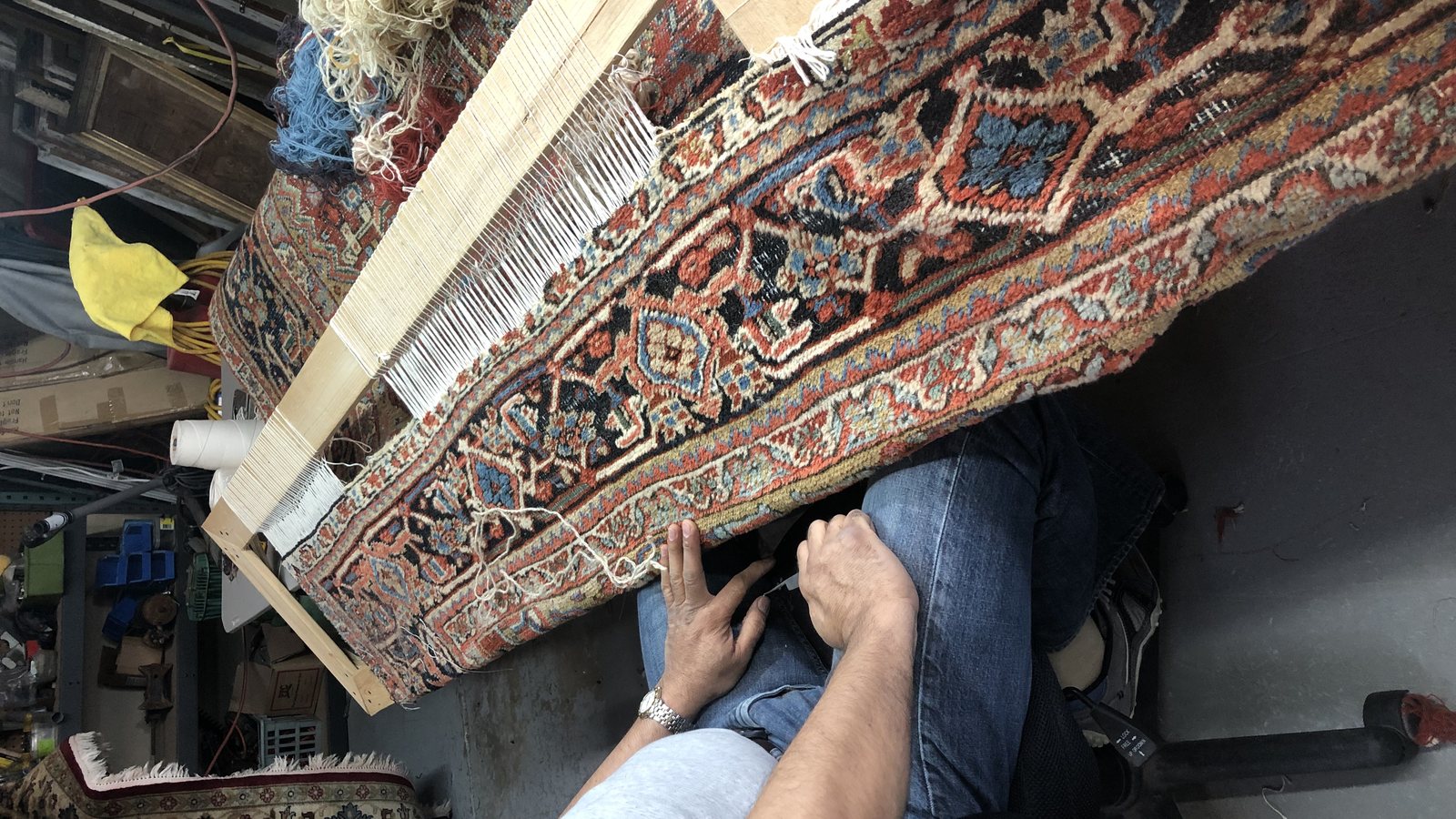
Fringe is the warp ends of the rug, not a trim, so 139 days a year of damp working on cotton warps shows up there before it shows up anywhere else.
Once the ends let go the rug starts unravelling from the edge inward, which is why a fringe that has begun to shed is worth dealing with while it is still a fringe job.
Figures above are from the ERA5 reanalysis record for the five years from 2021 through 2025,
taken at the center of the Macon service area. If what you are seeing on your rug
matches any of this, send photographs and we will tell you which of these it is.